


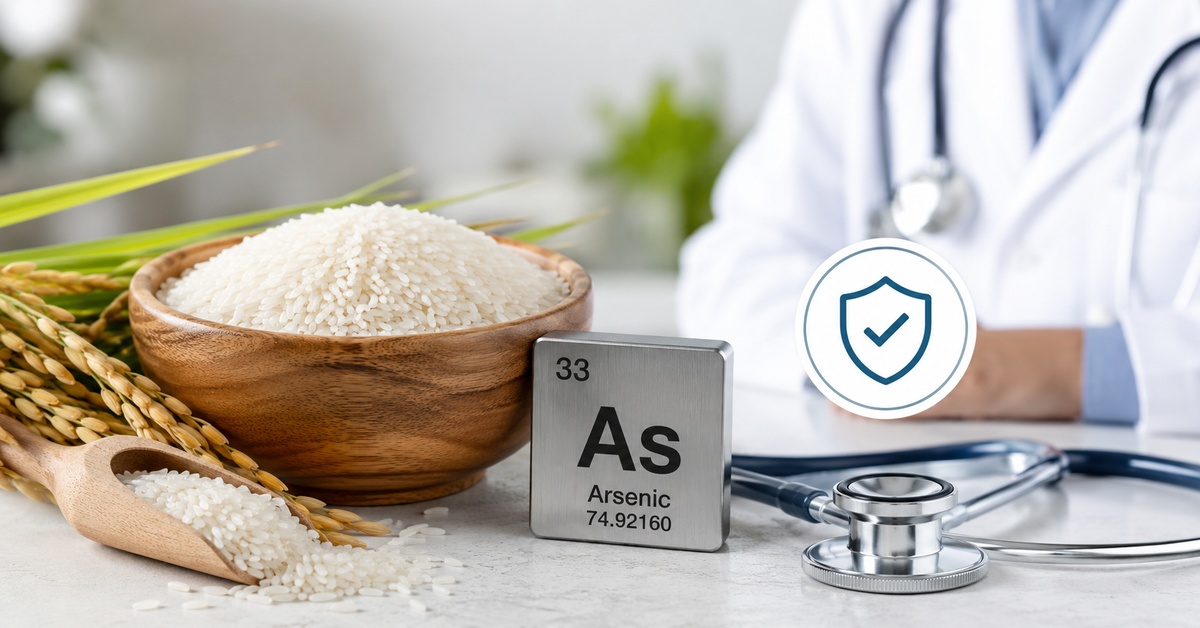
Is Your Rice Safe? A Murphy Family Doctor’s Honest Guide to Arsenic and Your Favorite Desi Dishes
Medically reviewed by Dr. Hina Zaman, MD, board-certified family physician at Family Care USA in Murphy, Texas.
Arsenic in Texas rice tends to run higher than rice from most other growing regions, and if your family eats biryani on Sundays and daal chawal most weeknights, you probably want the real story instead of another scary headline. A nationwide lab test published in July 2026 found measurable inorganic arsenic in every single rice product it checked, and in 42% of them, the level was high enough that eating one serving a day, year after year, would meaningfully raise an adult’s risk of certain cancers and type 2 diabetes.
You do not need to throw out your rice cooker. But if rice shows up on your table five or six nights a week, which describes most of the South Asian and Texas families I see in my Murphy office, it’s worth five minutes to understand what’s actually going on and what to do about it.
The short version: Rice absorbs more arsenic than almost any other food we eat regularly. Where your rice was grown and how you cook it both make a real difference. Neither one requires giving up rice.
What Inorganic Arsenic Actually Is, and Why Rice Soaks Up So Much of It
Arsenic occurs naturally in soil, rock, and groundwater almost everywhere on earth. It comes in two basic forms: organic arsenic, which passes through the body with little concern, and inorganic arsenic, the form linked to cancer and other long-term health effects.
Here’s the mechanism. Rice is one of the only major food crops grown standing in flooded fields. That constant contact with water and soil lets the plant pull in far more arsenic through its roots than crops grown in dry soil, like wheat or corn. The plant then uses that arsenic the same way it would use silicon, to build the structure of the grain itself. So the arsenic doesn’t stay in the husk. It ends up in the part you eat.
That’s the core reason rice carries more arsenic than nearly anything else in a typical grocery cart, according to the FDA’s ongoing food safety monitoring.
What a New Nationwide Test Found About Arsenic in Rice
Consumer Reports bought 52 rice products off store shelves this year and ran lab tests on 142 samples, covering basmati, jasmine, sushi, arborio, brown, white, and parboiled varieties, plus seasoned rice mixes. Every single sample contained detectable inorganic arsenic. None were arsenic-free.
The amount varied a lot by type. Here’s what the average levels looked like, measured in parts per billion (ppb):
| Rice Type | Average Inorganic Arsenic (ppb) |
|---|---|
| Basmati | 55 ppb |
| Sushi rice | 57 ppb |
| Arborio | 64 ppb |
| Jasmine | 87 ppb |
| Long and short grain | 101 ppb |
| Parboiled | 101 ppb |
Brown rice consistently tested higher than white rice of the same variety. Across the whole test, brown rice averaged 113 ppb and white rice averaged 72 ppb, since arsenic concentrates in the bran layer that milling removes from white rice. There’s currently no federal safety limit for arsenic in rice generally. The one exception is infant rice cereal, where the FDA has set an action level of 100 ppb, which we’ll come back to below.
The same test also screened for cadmium, lead, and mercury. Researchers usually watch arsenic and cadmium in rice together, since both are heavy metals that build up in the body over years rather than passing through. Arsenic showed up as the bigger concern by far, but it’s worth knowing cadmium is in the picture too. More on that when we get to grain swaps below.
Why Arsenic in Texas Rice Runs Higher Than Rice From Punjab or Sindh
This is the part that surprises most of my patients. You’d think rice grown closer to home would be the safer choice. For arsenic specifically, it’s often the opposite.
Research published through the National Institutes of Health has found that rice grown in the South-Central United States, meaning Arkansas, Louisiana, Mississippi, Missouri, and Texas, consistently contains more arsenic than rice grown in California, or than rice imported from India, Pakistan, and Thailand.
The reason traces back almost a century. That same stretch of the American South spent decades as prime cotton country, and cotton farmers relied heavily on arsenic-based pesticides to fight the boll weevil. Those pesticides were banned by the 1980s, but the arsenic never left. It settled into the soil and stayed there. When a lot of that same land was later converted to rice paddies, which need standing water exactly like old cotton fields didn’t, the rice started pulling up decades-old pesticide residue right along with the water it needs to grow.
Buying organic doesn’t solve this particular problem. Organic farming standards govern what goes into the soil going forward. They can’t undo arsenic that’s already been sitting there since before most of us were born.
The Health Risks Doctors Are Actually Watching For
To be clear, one bowl of rice at a wedding dinner is not going to hurt you. The concern with arsenic is cumulative exposure over years, not any single meal. That distinction matters, so let’s not skip past it.
What the research does show is that regular, long-term exposure to inorganic arsenic is linked to:
- Skin cancer and bladder cancer
- Cardiovascular disease, including effects on the heart and blood vessels
- Type 2 diabetes
- Developmental effects in fetuses, infants, and young children, whose bodies are still growing
Why does this land differently for our community? Collin County has a large, health-conscious South Asian population, and rice is often eaten daily rather than a few times a week. That daily habit matters even more given how we manage diabetes risk in South Asian patients, since type 2 diabetes already shows up earlier and more often in this community. Daily, decade-after-decade exposure is exactly the pattern that turns a low-level risk into a meaningful one. This isn’t about fear. It’s about the same logic we already apply to sun exposure or salt intake: the dose over time is what counts.
The Good News: You Don’t Have to Give Up Rice
You have more control over this than the headlines suggest. Two decisions, where your rice comes from and how you cook it, cover most of the reduction you can realistically get.
Choose Rice by Where It’s Grown, Not Just the Brand on the Bag
Based on the testing above, white basmati rice from India or Pakistan and sushi rice consistently land at the low end for arsenic. Jasmine rice from Thailand and California-grown rice also test well. Rice labeled simply “Product of USA,” without a specific growing region, is more likely to come from the South-Central states where arsenic runs higher.
Doctor’s grocery tip: Flip the bag over and check the origin. Look for India, Pakistan, Thailand, or California specifically. A vague “USA” label with no state or region listed is the one I’d skip.
Cook It Differently, and Cut the Arsenic Nearly in Half
Most of us were taught to cook rice with just enough water for the grains to absorb it all, a roughly 1-to-2 ratio. The problem is that any arsenic that leaches out during cooking stays right there in the pot and gets reabsorbed into the rice.
Consumer Reports tested several cooking methods against each other in 2026 to see which one actually worked. Quick rinsing and soaking barely made a dent, cutting arsenic by 5% or less. The method that won by a wide margin, called parboil and absorb, cut inorganic arsenic by 58% in white rice and 50% in brown rice. Here’s how it works:
- Bring water to a rolling boil. Use a generous amount, not the amount you’d normally measure out for absorption cooking.
- Add the rice and boil for 5 minutes. Just 5 minutes, uncovered.
- Drain it completely. Pour the rice into a colander and let that first batch of water go down the drain, arsenic and all.
- Finish it like normal. Return the rice to the pot, add fresh water in your usual absorption ratio, and cook until the water is absorbed and the rice is tender.
One honest trade-off worth knowing: any method that pulls extra water through the rice also washes out some of the iron and B vitamins added to enriched white rice, though the effect is smaller for brown rice. For most families eating a varied diet, that’s a fair trade for cutting your arsenic exposure roughly in half. If you’re pregnant or your child is iron-deficient, mention your rice-cooking habits at your next visit so we can factor it in.
Rotate in a Few Grains That Barely Register Any Arsenic
You don’t have to eat rice every single night to keep it in your rotation. A few nights a week, try swapping in:
- Millet, bajra, or jowar, staples with deep roots in South Asian cooking that carry almost no arsenic
- Quinoa, which works well in place of rice under curries or as a pilaf base
- Bulgur wheat, a good stand-in for upma or a quick pilaf
When Consumer Reports tested whole grains like these alongside rice in 2026, even the highest-arsenic grain in the bunch, oats, still had less than a quarter of the arsenic found in the lowest-arsenic rice they tested. One honest caveat: a few of these grains carried more cadmium than some of the rice samples, and quinoa had the most of the bunch. Even so, it stayed well below the level Consumer Reports considers a concern. Small changes like this add up more than people expect.
A Special Note for Babies, Toddlers, and Moms-to-Be
This is the group I’m most careful about. Infants eat far more rice relative to their body weight than adults do, and their developing bodies are more sensitive to arsenic’s effects. The CDC specifically recommends offering iron-fortified oat, barley, or multigrain infant cereal instead of relying on rice cereal as the only first food. The American Academy of Pediatrics agrees, and does not recommend rice milk for infants at all.
If your baby is already eating rice cereal, that’s not a reason to panic. It’s a reason to diversify. Talk with us about starting solid foods with a mix of grains rather than rice alone, and save rice cereal for occasional use rather than a daily habit. The FDA also advises pregnant women to eat a variety of grains rather than leaning heavily on rice.
What I Tell Families in My Murphy Office
I hear a version of the same story often. A busy mom in Plano is managing school pickups, cooking for three generations under one roof, and rice is the one dinner staple that never fails. Her own health questions keep getting pushed to next month.
Here’s what I actually tell her: you don’t need to overhaul your kitchen overnight. Switch to a basmati from India or Pakistan if you haven’t already, drain your cooking water instead of absorbing it all, and mix in millet or quinoa a couple of nights a week. That’s it. Those three habits do most of the work, and none of them ask you to give up the food that sits at the center of your family’s table.
If you’re in Murphy, Plano, or anywhere in Collin County and want to talk through your family’s diet, your child’s first foods, or your own annual physical and preventive screenings, our team is here and happy to help.
Frequently Asked Questions
Is brown rice safer than white rice because it’s less processed?
Not when it comes to arsenic. Arsenic concentrates in the bran layer, which stays on brown rice but gets removed when white rice is milled. Brown rice consistently tests higher for arsenic than white rice of the same variety, even though it offers more fiber overall.
Does organic rice have less arsenic?
Not reliably. Most of the arsenic in South-Central U.S. rice comes from pesticide residue left in the soil decades ago, and organic certification doesn’t remove contamination that’s already there. Where the rice was grown matters more than whether it’s labeled organic.
How much rice is actually safe to eat?
There’s no single number that fits every person, but Consumer Reports’ 2026 testing offers a useful rule of thumb. For lower-arsenic types like basmati or sushi rice, they suggest capping it around 5 servings a week for adults and about 3 for kids. For other rice types, they suggest closer to 3 servings a week for adults and about 1 for kids. A serving is roughly a quarter cup of dry rice. Cooking with the parboil-and-absorb method and rotating in other grains gives you more room within those limits.
Should I stop giving my baby rice cereal completely?
You don’t need to eliminate it, but don’t make it your baby’s only grain. The CDC and AAP recommend offering oat, barley, or multigrain cereal along with, or instead of, rice cereal, especially in the early months of starting solids.
Should I worry about arsenic and cadmium in rice together?
Arsenic is the bigger concern of the two in rice specifically. Consumer Reports’ 2026 testing found cadmium levels in rice were low enough not to raise alarm, and only a small handful of alternative grains, quinoa most of all, edged higher on cadmium while still staying under their threshold of concern. Following the same steps that lower arsenic, choosing lower-arsenic rice, cooking with the parboil-and-absorb method, and rotating grains, keeps both in check.
Resources
- FDA: Arsenic in Food
- FDA: Action Level for Arsenic in Infant Rice Cereal
- CDC: Infant and Toddler Nutrition FAQs
- American Academy of Pediatrics: Arsenic Exposure
- National Institutes of Health: Cooking Rice in Excess Water Reduces Arsenic
- Consumer Reports: Reducing the Risk From Arsenic in Rice (2026 testing)
About Dr. Hina Zaman, MD
Dr. Zaman is a board-certified family medicine physician at Family Care Murphy, serving Murphy, Plano, and the greater Collin County community. She sees patients of all ages for preventive care, chronic disease management, and the everyday health questions that come up around the dinner table.