


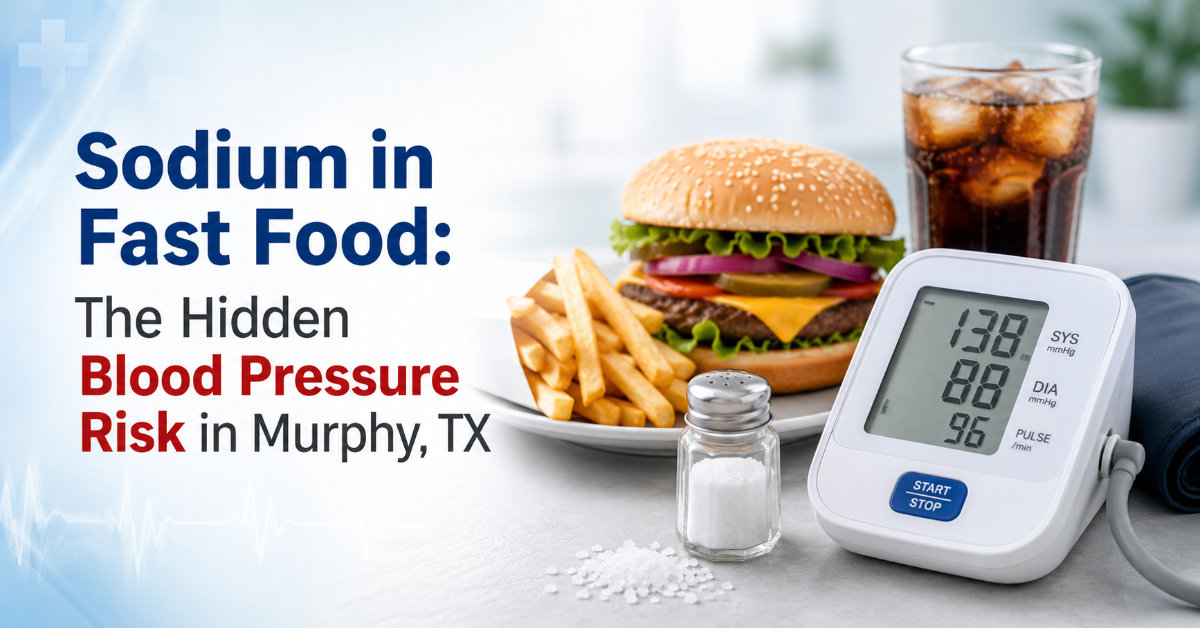
Grabbing Dinner on FM 544? Here’s What the Salt Is Doing to Your Blood Pressure
The sodium in fast food is easy to underestimate when you’re grabbing dinner on the way home from work or picking something up after your kid’s practice on FM 544. One bag, one drive-thru window, and you’ve likely covered most of your sodium for the entire day before you even sit down to eat it.
Murphy sits right in the middle of one of the busiest fast food corridors in Collin County. Whataburger, Raising Cane’s, Sonic, Braum’s, and a handful of other regulars line the same stretch families drive every single day. None of that is a problem on its own. The problem shows up when it becomes the default three or four nights a week and nobody’s tracking what’s actually in the bag.
Why Is Fast Food So Salty in the First Place?
You’re not imagining it, and you’re not wrong to wonder about the reason behind it. Fast food menus are formulated around what researchers call “hyperpalatable” food: specific combinations of fat, sugar, and sodium engineered to hit what the food industry calls the bliss point, the exact level of saltiness or sweetness that keeps you reaching for the next bite.
A 2019 study published in the journal Obesity defined hyperpalatable foods using precise thresholds, for example, any food pairing more than 25 percent of its calories from fat with sodium above 0.30 percent by weight. Using that definition, researchers found the share of hyperpalatable foods in the US food supply jumped from 49 percent to 69 percent between 1988 and 2018. Salt in a chicken sandwich or a burger isn’t an accident. It’s part of the formula.
Sodium also does real work that has nothing to do with flavor. It helps preserve pre-portioned ingredients, keeps fried food crisp under heat lamps, and holds moisture in meat during high-volume cooking. Fresh herbs and slow-cooked flavor are expensive and inconsistent at drive-thru scale. Salt is cheap, stable, and predictable.
As for the theory that salt makes you thirstier so you’ll order a bigger drink? That one’s popular, but it doesn’t hold up the way most people assume. A 2017 study led by researchers at Vanderbilt University Medical Center, conducted with Russian cosmonauts during a simulated Mars mission, found that a high-sodium diet actually decreased thirst over time. What it increased was hunger. Processing extra sodium takes energy, and the body responds by craving more food to keep up.
So the honest answer is that salt is there to make you want more. Just not necessarily more soda. It’s more likely to show up as another handful of fries, a second visit next week, or a bigger appetite at dinner.
Why the Sodium in Fast Food Adds Up Faster Than You Think
The American Heart Association recommends adults keep sodium under 2,300 milligrams a day, with an ideal limit closer to 1,500 milligrams for most adults, especially anyone already managing blood pressure. That’s roughly two-thirds of a teaspoon of salt for the entire day.
Here’s what that looks like in practice. Whataburger’s own published nutrition data lists a #1 Whataburger at 1,220 milligrams of sodium, a large order of fries at 350 milligrams, and a slice of Texas toast at 220 milligrams. Order that combination, skip the drink entirely, and you’re already at roughly 1,790 milligrams. That’s before the day’s coffee, breakfast, or dinner at home.
This isn’t really a Whataburger problem, or a Cane’s problem, or a Sonic problem. It’s a drive-thru problem. The sodium in fast food hides in sauce packets, seasoned fries, bacon add-ons, and bread across almost every quick-service menu, no matter which sign is out front.
What Extra Sodium Does to Your Blood Pressure
Sodium pulls water into your bloodstream. More fluid in the blood vessels means more pressure pushing against the vessel walls. Do that often enough, and your blood pressure stops resetting between meals. Over months and years, that constant extra pressure is what damages arteries, strains the heart, and raises stroke risk.
According to the CDC’s most recent data, nearly half of American adults, about 119.9 million people, have high blood pressure. Only around 1 in 4 of them have it under control. That gap is exactly where diet, and specifically sodium, does the most damage without anyone noticing until a routine checkup catches it.
I see this constantly in my Murphy practice, including among South Asian patients who are often surprised to learn their cardiovascular risk runs higher at a lower BMI than their neighbors. Between a fast food dinner on a hectic Tuesday and a home-cooked meal heavy on canned or packaged ingredients, the sodium adds up from both directions.
The 2025 AHA and American College of Cardiology guideline defines blood pressure categories this way:
- Normal: under 120 systolic and under 80 diastolic
- Elevated: 120 to 129 systolic and under 80 diastolic
- Stage 1 hypertension: 130 to 139 systolic or 80 to 89 diastolic
- Stage 2 hypertension: 140 or higher systolic or 90 or higher diastolic
If your home readings sit consistently in the Stage 1 range or higher, that’s worth a conversation with your doctor, not a wait-and-see approach.
The Eating Pattern That Actually Lowers Blood Pressure
The Mayo Clinic’s DASH diet guidance isn’t about cutting out flavor. It’s built around potassium, calcium, and magnesium, the minerals that help your body counteract sodium’s effect on blood pressure. Vegetables, fruit, beans, and lean protein do the heavy lifting. None of that requires giving up FM 544 entirely.
Practical Swaps for Eating Out on FM 544
You don’t need to memorize a nutrition label at every stop. A few habits cover most of it:
- Order it grilled instead of fried where the menu allows it. Grilled chicken sandwiches typically run several hundred milligrams lower in sodium than the fried version.
- Ask for sauce on the side, or skip the second dipping sauce. Most of the sodium in a sauced meal isn’t in the protein, it’s in the sauce.
- Skip or split the bread add-on. Texas toast, a bun upgrade, or garlic bread each carry 150 to 250 milligrams on their own.
- Choose water, unsweetened tea, or a small drink instead of a large one. It won’t change the sodium count, but it keeps the meal from becoming a two-course event.
- Add a side salad or fruit cup in place of a second fried side when it’s on the menu.
For multigenerational households splitting time between home-cooked meals and takeout, the same rule applies either way. A biryani made at home with fresh spices instead of packaged seasoning mixes can be just as satisfying and considerably lower in sodium than either the packaged version or the drive-thru alternative.
When to Talk to a Doctor About Your Blood Pressure
Most people don’t feel high blood pressure. That’s exactly why it earned the nickname the silent killer. A home monitor is the only reliable way to catch it early, and it’s worth checking a few times a week if fast food is a regular part of your routine.
In my practice, I see patients who are genuinely surprised their blood pressure crept up even though they “never add salt” at the table. The truth is most of our sodium was never in the shaker to begin with. It was already cooked into the meal before it reached the table or the car.
If your readings are running at 130 over 80 or higher on a regular basis, or if you’re managing chronic conditions like diabetes or thyroid disease alongside blood pressure concerns, don’t wait for your next annual physical to bring it up. If you’re in Murphy, Plano, or anywhere in Collin County and want a high blood pressure doctor near you, Dr. Zaman’s team can walk through your numbers, your chronic disease management options, and how blood pressure connects to stroke and diabetes risk. Catching it during a routine preventive care visit is a lot easier than catching it in an emergency room.
FAQ
How much sodium is in a typical fast food meal?
The sodium in fast food combo meals, burger or chicken sandwich with fries and a bread side, commonly runs between 1,500 and 2,000 milligrams. That’s close to or past the AHA’s ideal daily limit of 1,500 milligrams in one sitting.
Can I still eat fast food if I have high blood pressure?
Yes, in moderation and with a few adjustments. Skipping the extra sauce, choosing grilled over fried, and limiting bread add-ons can cut a meal’s sodium significantly without cutting out the drive-thru altogether.
What is a healthy daily sodium limit?
The American Heart Association recommends under 2,300 milligrams a day for most adults, with an ideal target closer to 1,500 milligrams for anyone managing or trying to prevent high blood pressure.
Does drinking more water help offset high sodium intake?
Water supports normal kidney function, but it doesn’t erase the effect of a high-sodium meal on blood pressure in the short term. Reducing sodium at the source matters more than trying to flush it out afterward.
When should I see a doctor about high blood pressure?
If home readings consistently sit at 130 over 80 or higher, it’s time for an evaluation rather than continued at-home monitoring alone. Family history, diabetes, and thyroid disease can all raise the stakes further.
What is FM 544?
FM 544 (Farm to Market Road 544) is a state-maintained secondary highway in Collin County, Texas. It runs for about 11 miles, connecting the cities of Plano, Murphy, and Wylie in the northern part of the Dallas–Fort Worth metroplex.
Resources