

Measles Just Showed Up in Montgomery County. Here’s What Texas Families Should Know.
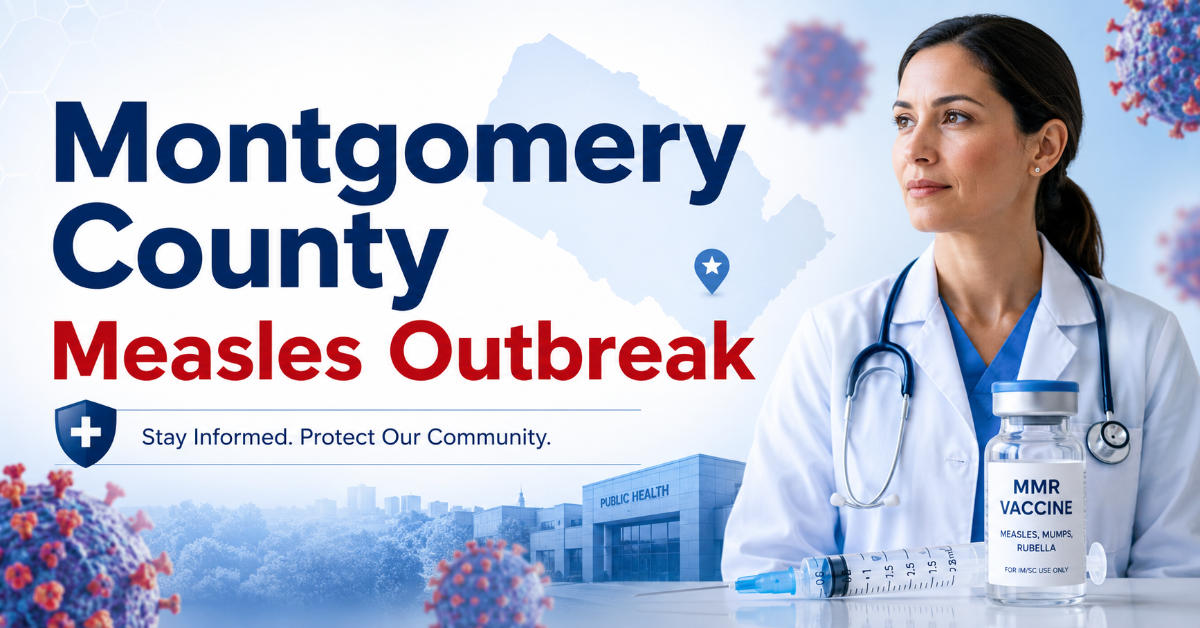
A new Montgomery County measles outbreak just prompted a Texas health alert, and if your family’s MMR shots are out of date, this is worth five minutes of your time. On July 23, the Texas Department of State Health Services confirmed four measles cases in one unvaccinated family after they were exposed to a traveler who brought the virus into the state. One of them, a woman in her twenties, is currently hospitalized. Here’s what actually happened, why it matters even if you don’t live anywhere near Houston, and what to do if you’re not sure your own family is covered.
What Happened in Montgomery County
Montgomery County sits just north of Houston, and it hadn’t logged a measles case this year until last week. Four members of the same family tested positive after contact with someone who traveled into Texas from out of state while contagious. None of the four had been vaccinated.
One of them, a woman in her twenties or thirties, was hospitalized. The Montgomery County Public Health Department confirmed the first three cases on July 21 and the fourth two days later. That prompted a local DSHS health alert on July 23, followed by wider public notice this week.
These new cases bring Texas’s 2026 measles count to 188. That number matters, and here’s why.
Wait, Isn’t Texas’s Measles Outbreak Supposed to Be Over?
Fair question. Last year, Texas had its worst measles outbreak since 1992. It started with a single case in Gaines County in January 2025, spread through under-vaccinated communities in West Texas, and grew to more than 750 confirmed cases before health officials declared it over in August. Ninety-nine people were hospitalized. Two school-age children died. It was the first time in a decade the United States had lost a child to measles.
This year looks very different on paper. Texas has logged 188 measles cases in all of 2026, down sharply from over 800 for the full year of 2025. So no, this Montgomery County measles outbreak isn’t a sign that last year’s outbreak flared back up. It’s something else entirely: a fresh, unrelated cluster, seeded by a single traveler, in a family with no immunity at all.
In my practice, I remind patients that a quiet year doesn’t mean the vaccine matters less. It means the vaccine is doing its job, right up until one household isn’t protected. Then the math changes fast.
The National Numbers Are Not Going the Right Direction
Zoom out from Texas and the picture gets more serious. As of July 23, the CDC has confirmed 2,318 measles cases across 45 states and jurisdictions this year, a total that has already passed all of 2025’s count of 2,289. That makes 2026 the worst year for measles in the United States since 1991, before the disease was declared eliminated on American soil in 2000.
Ninety-three percent of this year’s cases are tied to a known outbreak, and the large majority involve someone who was unvaccinated or whose vaccination status was unknown. Texas isn’t even the biggest driver anymore. Seven states now account for more than 84% of the national total, led by South Carolina with over 650 cases and Utah with more than 500. Texas, Virginia, Florida, Pennsylvania, and Arizona round out the rest of that list. But viruses don’t check state rankings before they spread. A single infected traveler was all it took in Montgomery County, and it could just as easily happen in a county that has never had a case.
Why One Unvaccinated Family Can Become a Statewide Story
Measles needs roughly 95% of a community vaccinated to stop spreading. Fall below that line, even in one household or one neighborhood, and the virus finds room to move. It’s one of the most contagious diseases known to medicine. An infected person can pass it to about nine out of ten unvaccinated people they’re around, and the virus can hang in the air of a room for up to two hours after that person has already left.
That’s the mechanism behind Montgomery County. One traveler, one exposure, one unvaccinated family, four cases within about a week. Picture a family hosting relatives who just flew in for a wedding or a summer visit. Everyone’s excited, nobody’s thinking about vaccine records. That’s exactly the kind of gap measles is built to exploit.
What Measles Actually Looks Like
Here’s the tricky part about measles. It doesn’t look like measles at first.
Symptoms usually start 7 to 14 days after exposure, though incubation can stretch to 21 days. And they begin looking a lot like a bad cold or the flu:
- High fever, often 104°F or higher
- Cough
- Runny nose
- Red, watery eyes
The telltale rash doesn’t show up until a few days later. It starts as flat red spots on the face, then spreads down the neck and trunk to the rest of the body. By the time the rash appears, the contagious window has already been open for days.
Here’s the part that catches families off guard: a person with measles is contagious about four days before the rash appears and four days after. Someone can be spreading the virus before they, or anyone around them, even knows they’re sick.
When to Call Us, and When to Go Straight to the ER
If you suspect measles exposure or symptoms in your family, call our office before you come in. That’s not a formality. It gives us time to prepare a room and protect other patients in the waiting area, including infants and immunocompromised patients who can’t be vaccinated.
Go to the emergency room right away if you or your child develop:
- Difficulty breathing
- Severe dehydration
- Confusion or disorientation
- A sudden, unexplained change in behavior
In young children specifically, watch for a bluish tint around the mouth, crying without tears, a sharp drop in appetite, or unusually low energy. Those can point to the complications that make measles genuinely dangerous, including pneumonia and swelling of the brain.
The MMR Vaccine Still Works, and Works Well
Two doses of the MMR vaccine are about 97% effective at preventing measles. One dose alone gets you to roughly 93%, according to the CDC. It remains the single best tool available, more effective than masking, more effective than avoidance, more effective than hoping the outbreak stays in someone else’s county.
The standard schedule is a first dose at 12 to 15 months and a second between 4 and 6 years old. If you’re traveling to an area with active transmission, or if your child was potentially exposed, we can move that timeline up. Babies 6 to 11 months old can get an early dose, though they’ll still need the regular two-dose series later on.
Adults born before 1957 are generally considered immune from likely childhood exposure. If you were born after that and only had one MMR dose, or you’re honestly not sure, it’s worth checking your records with us. That matters especially for healthcare workers, teachers, and anyone who travels internationally.
The vaccine is easy to get. Our office offers preventive care and immunization visits as part of routine care, and we handle adolescent and pediatric vaccine catch-up as well. The Texas Vaccines for Children and Adult Safety Net programs cover free or low-cost doses for those who qualify, and pharmacies across Texas can vaccinate people 14 and older without a prescription.
A Note for Families With Ties to South Asia
A good number of families in our practice split their time, or at least their holidays, between Texas and Pakistan, India, or Bangladesh. Measles is still common in parts of South Asia, and several of this year’s U.S. cases have been traced back to international travel. If a trip is coming up, confirm that everyone traveling, including grandparents and adult children, has documented proof of two MMR doses before departure. We covered this in more detail in our full measles and MMR guide for Collin County families, including the complete vaccine schedule.
If You Think Your Family Was Exposed
- Call us first. Don’t walk straight into the waiting room. Let us know so we can take precautions before you arrive.
- Watch for symptoms for 21 days after the exposure date.
- Keep unvaccinated family members home from school, work, and public spaces during that window.
- Get vaccinated right away if you’re not. A dose given within 72 hours of exposure can prevent the illness or make it significantly milder.
If you’re in Murphy, Plano, or anywhere in Collin County and you’re not sure your family’s MMR records are current, that’s an easy thing to fix. Reach out to our office and we’ll check your records and get you scheduled.
Frequently Asked Questions
Is measles actually a big problem in Texas right now?
It’s a mixed picture. Texas cases are down sharply this year, from more than 800 in 2025 to 188 so far in 2026. But the Montgomery County cluster shows how quickly a new outbreak can start from just one unvaccinated household, and nationally, 2026 is already the worst measles year since 1991.
How is this different from last year’s outbreak in West Texas?
They’re unrelated. The 2025 outbreak began in Gaines County and spread through under-vaccinated rural communities, eventually reaching more than 750 cases. Montgomery County is a new, separate cluster sparked by a single traveler, contained so far to one family.
My child already had one MMR dose. Is that enough?
One dose gives about 93% protection. The second dose, usually given between ages 4 and 6, brings that up to roughly 97%. If your child is overdue for dose two, especially with an active cluster in the state, now is a good time to get it done.
Can a vaccinated person still get measles?
It’s possible but uncommon. Vaccinated people who do get measles tend to have much milder illness and are far less likely to spread it to others. Among this year’s confirmed U.S. cases, the CDC reports 93% involved someone unvaccinated or with unknown vaccination status.
Where can my family get an MMR vaccine near Murphy or Plano?
Our office provides MMR vaccines for both children and adults, and we can pull up your family’s records during a routine visit. Local pharmacies can also vaccinate patients 14 and older. Contact us to schedule.
Resources
- Texas DSHS: Health Alert, Measles Outbreak in Montgomery County
- CDC: Measles Cases and Outbreaks, 2026 Data
- CDC: Measles Vaccination Guidance
- CDC: About Measles, Symptoms and Complications
- Mayo Clinic: Measles Symptoms and Causes
This post reflects data from the Texas Department of State Health Services and the CDC as of July 30, 2026. Measles case counts are provisional and updated weekly. This article is for informational purposes only and does not replace personalized medical advice. If you have questions about your family’s vaccination status, please contact our office directly.